Short Story Its All Over Now Baby Blue
| "It'southward All Over Now, Baby Blue" | |
|---|---|
| Song by Bob Dylan | |
| from the album Bringing It All Back Abode | |
| Released | March 22, 1965 (1965-03-22) |
| Recorded | Jan xv, 1965 |
| Studio | Columbia Recording, New York Metropolis |
| Genre | Folk stone, folk |
| Length | 4:12 |
| Label | Columbia |
| Songwriter(s) | Bob Dylan |
| Producer(southward) | Tom Wilson |
| Audio sample | |
| |
"Information technology's All Over At present, Babe Bluish" is a song written and performed by Bob Dylan and featured on his Bringing It All Dorsum Home anthology, released on March 22, 1965, by Columbia Records. The vocal was recorded on January xv, 1965, with Dylan'due south acoustic guitar and harmonica and William E. Lee's bass guitar the only instrumentation. The lyrics were heavily influenced past Symbolist poetry and bid farewell to the titular "Baby Blue". In that location has been much speculation near the existent life identity of "Babe Blue", with possibilities including Joan Baez, David Blueish, Paul Clayton, Dylan'south folk music audience, and even Dylan himself.
"It's All Over Now, Baby Blue" has been covered many times by a variety of artists, mosty notably by Them, Baez and the Byrds. Them's version, released in 1966 influenced garage bands during the mid-60s and Beck afterward sampled it for his 1996 single "Jack-Ass". The Byrds recorded the song twice in 1965 as a possible follow up single to "Mr. Tambourine Man" and "All I Actually Want to Do", but neither recording was released in that course. The Byrds did release a 1969 recording of the song on their Ballad of Easy Rider album.
Bob Dylan's version [edit]
Composition and recording [edit]
Bob Dylan most likely wrote "Information technology'due south All Over Now, Baby Bluish" in January 1965.[one] The principal take of the song was recorded on January 15, 1965, during the sessions for the Bringing It All Dorsum Dwelling album and was produced by Tom Wilson.[2] The track was recorded on the same day Dylan recorded the other iii songs on side 2 of the album: "Mr. Tambourine Man", "Gates of Eden" and "It's Alright Ma (I'thou Only Bleeding)".[3] Dylan had been playing those other songs live for some time, assuasive them to evolve earlier recording of the anthology commenced.[ii] For "It'south All Over Now, Baby Blue", still, Dylan wanted to tape the song before he became as well familiar with it.[ii] At that place were at to the lowest degree two studio recordings prior to the ane that was released on the album. Dylan recorded a solo audio-visual version on January 13, 1965 (outset released in 2005 on The Bootleg Serial Vol. 7: No Direction Home) and a semi-electrical version on January 14.[2]
The version of the vocal on the album is sparsely arranged with Dylan accompanying himself on acoustic guitar and harmonica, with William East. Lee playing bass guitar.[2] Author Clinton Heylin states that the vocal is another of Dylan'due south "'go out in the real globe' songs, like "To Ramona", though less conciliatory – the tone is crueler and more than enervating."[4] Equally well as being the last track on Bringing It All Back Home, "Information technology's All Over Now, Babe Bluish" was also the final song to exist recorded for the album.[two]
Bill Janovitz of AllMusic describes the music as cute, with folk guitar chord changes and a somber melody, while the chorus, with its line "and it'southward all over now, Babe Blue" has a heartbreaking quality to information technology.[v] Like other Dylan songs of the menstruation, such every bit "Chimes of Freedom" and "Mr. Tambourine Man", the lyrics of "Information technology's All Over Now, Baby Blue" acquit the strong influence of Symbolist poets such equally Arthur Rimbaud.[five] Lines such as "take what yous have gathered from coincidence" reflect the I Ching philosophy that coincidence represents more mere run a risk.[one] [6] The song was described by Q magazine every bit, "The nigh toxic of strummed kiss-offs, with not a snowball'southward chance in hell of reconciliation." Dylan, later describing the song, said that "I had carried that vocal around in my head for a long time and I call back that when I was writing it, I'd remembered a Gene Vincent song. It had always been one of my favorites, Baby Bluish... 'When first I met my baby/she said how do you exercise/she looked into my eyes and said/my name is Baby Blueish.' Information technology was one of the songs I used to sing back in high school. Of grade, I was singing nearly a dissimilar Infant Blue."[7]
Identity of "Baby Blue" [edit]
Dylan'southward two previous albums, The Times They Are A-Changin' and Another Side of Bob Dylan both concluded with a farewell song, "Restless Good day" and "Information technology Own't Me, Baby" respectively.[viii] "It's All Over At present, Babe Bluish" concludes Bringing It All Back Domicile in consequent mode.[8] Much speculation has surrounded who or what the "Baby Blue" to whom Dylan is singing bye is. Although Dylan himself has remained mute on the subject area, Dylan scholars believe that information technology is probably an amalgam of personalities inside Dylan's social orbit. One person who has been regarded every bit the subject of the song is folk singer Joan Baez.[6] [8] Dylan and Baez were still in a human relationship and were planning to tour together, but Dylan may have already been planning to go out the relationship.[8] Some other possibility is a singer-songwriter named David Blue.[i] A friend or acquaintance of Dylan's from his days in New York City'due south Greenwich Hamlet, Blue is pictured on the cover of Dylan and the Band'due south The Basement Tapes album wearing a trench glaze.[5] Withal another possibility is Dylan'south one-time friend, folk singer Paul Clayton.[1] [two] Although Clayton had been Dylan's friend throughout 1964, and had accompanied Dylan on the road trip across the United States on which "Chimes of Freedom" and "Mr. Tambourine Human being" were written, by 1965 he may have become more devoted to Dylan than Dylan was comfortable with, and Clayton'southward use of amphetamines may take made him difficult to be around.[1] [2] However, author Paul Williams, in his volume Performing Artist: Volume One 1960–1973, counters that "Dylan may have been thinking of a particular person as he wrote it, merely non necessarily", calculation that the vocal has such a natural, flowing structure to it, that it could "hands have finished writing itself before Dylan got around to thinking virtually who 'Infant Bluish' was."[4]
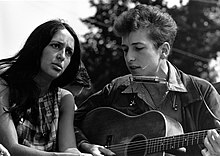
1963 photo of Joan Baez, left, who has sometimes been regarded as the subject of the song and also covered information technology, with Bob Dylan, who wrote the song
Another interpretation of the song is that it is directed at Dylan's folk music audition.[9] The vocal was written at a time when he was moving away from the folk protest movement musically and, as such, can exist seen as a good day to his days as an acoustic guitar-playing protestation singer.[5] Dylan's choice of performing "It's All Over At present, Baby Blue" as his last audio-visual vocal at the infamous Newport Folk Festival of 1965, after having had his electrical ready met with boos, is frequently used as evidence to support this theory.[five] That item functioning of the song is included in Murray Lerner's picture show The Other Side of the Mirror.[five]
Yet another estimation is that Dylan is directing the farewell to himself, peculiarly his acoustic performer self.[vi] [eight] [9] [10] [11] The opening line "You must leave now" can be a command, similar to the line "Get abroad from my window" that opens "Information technology Ain't Me, Infant".[10] But information technology can also exist an imperative, meaning just that it is necessary that you leave.[x] And the song is as much nigh new ancestry as it is about endings.[1] The song not only notes the requirement that Baby Blue leave, but also includes the hope that Baby Blue will move frontwards, in lines such equally "Strike another lucifer, get start afresh".[i] If Dylan is singing the song to himself, then he himself would be the "vagabond who's rapping at your door / standing in the clothes that you in one case wore".[x] That is, the new, electric, surrealist Dylan would exist the vagabond, non withal having removed the "clothes" of the old protest singer.
Alternatively, the vagabond and "stepping stones" referenced in the song have been interpreted as Dylan'south folk audience whom he needs to exit behind.[six] [8] He would also exist telling himself to "Forget the dead y'all've left, they volition not follow you."[eleven] Others to whom he may be saying good day in the vocal are any of the women he had known, the political left or to the illusions of his youth.[11]
Finally, of course, Bob Dylan's own eyes were celebrated by Joan Baez in her memory vocal Diamonds & Rust as "bluer than robins' eggs".
Legacy [edit]
In add-on to appearing on the Bringing Information technology All Back Home anthology, "It's All Over Now, Baby Blue" was also included on the compilation albums Bob Dylan'southward Greatest Hits Vol. II (1971), The Essential Bob Dylan (2000), Dylan (2007), and the United kingdom version of Bob Dylan's Greatest Hits (1967).[5] Dylan played the song for Donovan in his hotel room during his May 1965 bout of England in a scene shown in the 1967 D. A. Pennebaker documentary Dont Look Back.[five] [6] The first studio accept of the vocal, recorded on Jan 13, 1965, was released in 2005 on The Bootleg Serial Vol. seven: No Management Home, the soundtrack to Martin Scorsese's documentary No Direction Habitation,[5] and again in 2015 on the 6-disc and eighteen-disc versions of The Bootleg Series Vol. 12: The Cutting Border 1965–1966.
Dylan's May 1, 1965, live performance of the song in Liverpool, England is included in Alive 1962–1966: Rare Performances From The Copyright Collections (2018). A live version from Dylan'south famous May 17, 1966, concert in Manchester, England (popularly merely mistakenly known as the Royal Albert Hall concert) was released in 1985 on Dylan's box set Biograph and subsequently included on The Bootleg Series Vol. 4: Bob Dylan Live 1966, The "Imperial Albert Hall" Concert.[12] A live version from December 1975, recorded during the first Rolling Thunder Revue tour, is contained on The Bootleg Series Vol. 5: Bob Dylan Live 1975, The Rolling Thunder Revue (2002)[13] and The Rolling Thunder Revue: The 1975 Live Recordings (2019), while a June 1981 performance appears on the Palatial Edition of The Bootleg Series Vol. 13: Trouble No More 1979–1981 (2017).
In Nov 2016, all Dylan's recorded alive performances of the song from 1966 were released in the boxed set The 1966 Live Recordings, with the May 26, 1966, performance released separately on the album The Real Royal Albert Hall 1966 Concert.
As of 2009, Dylan continued to perform the vocal in concert.[14]
In a 2005 readers' poll reported in Mojo, "It'due south All Over Now, Infant Bluish" was listed as the number 10 all-fourth dimension best Bob Dylan song, and a like poll of artists ranked the song number seven.[fifteen] In 2002, Uncut listed information technology as the number 11 all-time all-time Bob Dylan song.[16]
Covers [edit]
Them'south version [edit]
| "It'south All Over Now, Infant Blue" | |
|---|---|
 1966 Dutch picture sleeve | |
| Unmarried by Them | |
| from the album Them Again | |
| B-side |
|
| Released |
|
| Recorded | 1965 |
| Studio | Decca Studios, London |
| Genre | Rock, folk rock |
| Length | iii:50 |
| Label | Decca |
| Songwriter(south) | Bob Dylan |
| Producer(s) | Tommy Scott |
| Audio sample | |
| |

Van Morrison covered "It'due south All Over Now, Infant Blue" both every bit a fellow member of Them and every bit a solo artist.
The Belfast band Them (featuring Van Morrison) recorded a cover of "It'south All Over Now, Baby Blue" that was get-go released on their album, Them Again, in Jan 1966 in the UK and April 1966 in the U.S.[17] [eighteen] [xix] The song was subsequently issued equally a single (b/w "I'm Gonna Dress in Black") in the Netherlands during October 1966 but failed to accomplish the Dutch Singles Chart.[twenty] It was later re-released in Deutschland in December 1973 with "Bad or Skillful" on the B-side, post-obit its appearance in the 1972 German television film, Die Rocker (aka Rocker).[21] [22] The single became a hit in Germany, first entering the charts in Feb 1974 and peaking at number 13, during a chart stay of 14 weeks.[23]
Morrison recalled his first encounter with Dylan's music in an interview in 2000: "I remember I heard [The Freewheelin' Bob Dylan] in a record shop in Smith Street. And I simply thought it was just incredible that this guy's not singing about 'moon in June' and he's getting abroad with it... The subject area matter wasn't pop songs, ya know, and I idea this kind of opens the whole affair up."[24] Morrison's record producer at the time, Bert Berns, encouraged him to find models for his songs, so he bought Dylan's Bringing Information technology All Back Home album in March 1965.[25] I of the songs on the album held a unique fascination for Morrison and he presently started performing "It'southward All Over At present, Baby Blue" in small clubs and pubs as a solo artist (without Them).[25]
Producer Tommy Scott was conscious of the importance of Dylan's music on the current pop scene and was eager for Morrison to cover "It'southward All Over At present, Baby Blue" during the 1965 sessions for Them's 2nd LP.[25] [26] Subsequently a failed, preliminary attempt to record the track with session pianist Phil Coulter at Regent Sound studios in London, Scott reconsidered his approach to the song.[26] Scott recalled in interview that "The number wasn't going downwardly, Van wasn't sure. Then the guys said he didn't fancy information technology and thought it was cheap considering I'd tried to become after the "Here Comes the Night" tempo."[26] The band returned to the song during a later session at Decca'southward recording studios.[26] Scott decided to rearrange the song'due south musical backing, incorporating a distinctive recurring blues riff and piano work from Them'south keyboard role player, Peter Bardens, resulting in a finished recording that the ring were satisfied with.[26] The song featured one of Morrison's most expressive vocals and included subtle changes to Dylan's lyrics; instead of singing "Forget the expressionless you lot've left" Morrison alters the line to "Forget the debts you lot've left".[24] [26]
Greil Marcus stated in a 1969 Rolling Stone review that "Only on Dylan'southward 'Information technology's All Over At present, Baby Bluish' does Van truly shatter all the limits on his special powers...Each annotation stands out as a special cosmos – 'the centuries of emotion that become into a musician's choice from one note to the next' is a phrase that describes the startling depth of this recording. Played very fast, Van'southward voice almost fighting for control over the ring, 'Baby Blue' emerges as music that is both dramatic and terrifying."[27] In recent years, author Clinton Heylin has noted that Them'south 1966 recording of the song is "that genuine rarity, a Dylan cover to match the original."[28] After Van Morrison left the ring in 1966, Them spinoff group, The Belfast Gypsies, recorded a comprehend of the song on their 1967 anthology, Them Belfast Gypsies.[29] [30] [31]
Them'south interpretation of the song, with Morrison as vocalist, became influential during the years 1966 and 1967, with several garage rock bands, including The Chocolate Watchband and The West Coast Pop Fine art Experimental Band, recording versions of the song that were indebted to Them's embrace version.[32] Beck used a sample of Them'due south 1966 recording of "It'south All Over Now, Baby Blue" as the ground for his single "Jack-Ass", which appeared on his 1996 anthology, Odelay (come across 1996 in music).[v] Insane Clown Posse later on sampled Beck's song as the ground for "Another Love Song", which appeared on their 1999 album, The Amazing Jeckel Brothers.[33] Hole'southward cover of the song too uses Them's recording every bit a design.[v] Them'south original 1966 version of the song has appeared in movies, such as the 1996 film Basquiat, the 1972 High german film Rocker by Klaus Lemke and the 2000 moving-picture show Girl, Interrupted.[22] [34] [35] [36]
In 1993, Van Morrison included Them'due south embrace of the song on his compilation album The Best of Van Morrison Volume Ii.[37] In addition to recording "It'south All Over At present, Baby Blue" with Them, Morrison has covered the song frequently in concert throughout his solo career, beginning in 1974, merely has never released a studio or live recording of it as a solo artist.[38] In 1984, Morrison fabricated a invitee appearance at one of Bob Dylan'southward concerts in London and the ii musicians performed a duet of "It's All Over At present, Baby Bluish".[39] Morrison and Dylan too sang a duet of "It's All Over Now, Baby Blue" at the terminal concert of Dylan's 1984 tour on July 8, 1984, at Slane Castle, Ireland.[40]
In a 2009 Paste magazine readers, writers and editors poll of the fifty All-time Bob Dylan Covers of All Time, Them's version of "It's All Over Now, Baby Blue" was ranked at number 28.[41]
The Byrds' version [edit]
| "It'due south All Over Now, Baby Blueish" | |
|---|---|
| Song by the Byrds | |
| from the album Ballad of Easy Rider | |
| A-side | "Jesus Is Just Alright" |
| Released | Oct 29, 1969 (1969-10-29) |
| Recorded | July 22, 1969 |
| Studio | Columbia, Hollywood, California |
| Genre | Folk rock, state rock |
| Length | iv:53 |
| Label | Columbia |
| Songwriter(due south) | Bob Dylan |
| Producer(s) | Terry Melcher |
The Byrds' recording of "It's All Over At present, Baby Blue" start saw release on October 29, 1969, as role of the band'south Ballad of Easy Passenger album.[42] [43] The song likewise appeared on the B-side of the band's December 1969 single, "Jesus Is Just Alright", which reached number 97 on the Billboard Hot 100 chart.[43] [44] The Byrds had previously attempted to record the vocal on ii divide occasions, some four years earlier, during studio sessions for their second album, Turn! Turn! Turn! [45]
The Byrds initially planned to release "It's All Over Now, Baby Blue" in 1965, as a follow-upward to their previous hit Bob Dylan covers, "Mr. Tambourine Man" and "All I Really Desire to Do".[46] The band'due south first endeavour at recording the song was on June 28, 1965: resulting in an irreverent, garage rock style have on the song.[42] [45] This version was deemed unsatisfactory and remained unreleased for 22 years, until its inclusion on the Never Earlier album in 1987.[47] The June 28, 1965, recording tin besides be heard on the 1996 expanded reissue of Plow! Plough! Plough! as well as on The Byrds and In that location Is a Season box sets.[45] [48] [49]
The band attempted a 2d recording of the vocal during August 1965.[45] A program manager from KRLA, who was present at the recording sessions, was impressed enough to play an acetate disc of the rails on air, plugging it as The Byrds' new single.[46] Even so, The Byrds soon abandoned the idea of releasing "Information technology's All Over Now, Baby Bluish" every bit their third single and instead issued the vocal "Turn! Turn! Turn!".[47] [l] The Byrds' August 1965 version of "It'southward All Over Now, Infant Bluish" has never been released.[45]
Guitarist and band leader, Roger McGuinn, returned to the composition during a July 22, 1969, recording session for the band's Ballad of Easy Rider album.[51] McGuinn decided to slow down the tempo and radically modify the song's system to fashion a more somber and serious version than those recorded in 1965.[42] In tandem with the slower tempo, the band dragged the syllables of each give-and-take out to emphasize the world-weariness of the song'south lyric.[46] Ultimately, McGuinn was dissatisfied with the recording of the song included on Ballad of Easy Rider, feeling that it tended to drag within the context of the album.[46] In addition to appearing on Ballad of Easy Rider, the Byrds' 1969 recording of "It'due south All Over Now, Baby Blue" can also be establish on the compilation albums The Byrds Play Dylan and The Very Best of The Byrds.[52]
Other covers [edit]
Many other artists have covered the song. Joan Baez, who has sometimes been speculated to be the discipline of the song, covered it on her 1965 album Adieu, Angelina.[53] Information technology is one of 4 Dylan covers on that anthology, the others being the title runway, "Mama, You Been on My Mind" (recorded as "Daddy, Y'all Been on My Mind"), and "A Hard Rain'southward a-Gonna Autumn".[53] Baez sings "It'southward All Over At present, Infant Blue" in a falsetto phonation, just retains the power of Dylan's version.[53] Baez has connected to perform the song at live concerts well into the modern era.[54]
George Harrison, who performed with Dylan in the Traveling Wilburys and also co-wrote the song "I'd Take You Anytime" with Dylan in November 1968,[two] did not cover the song, but did reference the championship in his 1987 single, "When We Was Fab". One of the lyrics in the song reads "But information technology's all over at present, baby bluish", which is a nod from Harrison to his friend Dylan.[55]
The vocal was a source of inspiration for Joyce Ballad Oates' short story "Where Are Yous Going, Where Have Yous Been?", prompting her to dedicate the story to Dylan.[56]
References [edit]
- ^ a b c d e f g Trager, O. (2004). Keys to the Rain. Billboard Books. pp. 319–321. ISBN0-8230-7974-0.
- ^ a b c d east f g h i Heylin, Clinton (1991). Bob Dylan: Behind The Shades – The Biography. Viking Penguin. ISBN0-670-83602-8.
- ^ Heylin, C. (2009). Revolution in the Air. Chicago Review Press. pp. 227–228. ISBN978-one-55652-843-9.
- ^ a b Williams, P. (2004). Bob Dylan: Performing Creative person, 1960–1973 (2nd ed.). Omnibus Press. p. 138. ISBN978-i-84449-095-0.
- ^ a b c d due east f thou h i j g "It's All Over Now, Infant Blue review". AllMusic . Retrieved July 23, 2009.
- ^ a b c d e Gill, A. (1998). Don't Think Twice, It's All Right. Thunder's Oral fissure Press. p. 77. ISBN1-56025-185-9.
- ^ Barolast, N. "n.B.uTHEMEN Infant Bluish". north-b-u.de. Archived from the original on July nineteen, 2011. Retrieved December 7, 2009.
- ^ a b c d east f Williamson, N. (2006). Bob Dylan: The Rough Guide (2nd ed.). Rough Guides. p. 225. ISBN978-1-84353-718-2.
- ^ a b Rogovov, S. (2009). Bob Dylan: Prophet, Mystic, Poet. Scribner. p. 86. ISBN978-1-4165-5915-3.
- ^ a b c d Hinchey, J. (2002). Like a Consummate Unknown. Stealing Home Press. pp. 99–106. ISBN0-9723592-0-half-dozen.
- ^ a b c Shelton, R. (1986). No Direction Dwelling house. Da Capo Press. p. 277. ISBN0-306-80782-3.
- ^ "The Bootleg Series, Vol. 4: The "Imperial Albert Hall" Concert". AllMusic . Retrieved July sixteen, 2009.
- ^ "Bootleg Series, Vol. 5: Bob Dylan Alive 1975 – The Rolling Thunder Revue". AllMusic . Retrieved July 16, 2009.
- ^ For example, "Brussels, Belgium Forest National April 22, 2009". BobDylan.com. Retrieved December 2, 2009.
- ^ "100 Greatest Dylan Songs". Mojo. November 2005. Retrieved July sixteen, 2009.
- ^ "Uncut – Tiptop xl Dylan Tracks". Uncut. June 2002. Retrieved July 16, 2009.
- ^ "It'south All Over Now, Babe Blue – Them Version". AllMusic . Retrieved December 6, 2009.
- ^ Dewitt, H. A. (1983). Van Morrison: The Mystic's Music. Horizon. p. 66. ISBN0-938840-02-9.
- ^ Rogan, J. (2006). Van Morrison: No Surrender. Random House. p. 608. ISBN0-09-943183-ane.
- ^ "It'southward All Over Now, Babe Blue - Dutch Unmarried". Dutch Charts. Retrieved December half-dozen, 2009.
- ^ "It's All Over Now, Infant Blue – German Single". Vanomatic.de. Archived from the original on July 26, 2011. Retrieved December 29, 2009.
- ^ a b "Soundtracks for Rocker". IMDb . Retrieved December ii, 2009.
- ^ "It's All Over Now, Baby Blueish – German Chart Information". Musicline.de. Archived from the original on September 29, 2012. Retrieved January 16, 2010.
- ^ a b Heylin, C. (2003). Can You Feel the Silence?: Van Morrison: A New Biography. Viking Penguin. pp. 134–135. ISBN0-670-89321-8.
- ^ a b c DeWitt, H. A. (1983). Van Morrison: The Mystic'south Music. Horizon. pp. sixteen–17. ISBN0-938840-02-9.
- ^ a b c d e f Rogan, J. (2006). Van Morrison: No Surrender. Random House. pp. 137–138. ISBN0-09-943183-one.
- ^ Marcus, Yard. (March 1, 1969). "Review:Astral Weeks". Rolling Stone.
- ^ Heylin, C. (2003). Can Y'all Feel the Silence?: Van Morrison: A New Biography . Chicago Review Press. pp. 116–117. ISBNi-55652-517-6.
- ^ "Them Biography". AllMusic . Retrieved Dec two, 2009.
- ^ "The Belfast Gypsies Biography". AllMusic . Retrieved Dec 2, 2009.
- ^ "Them Belfast Gypsies". AllMusic . Retrieved Dec 2, 2009.
- ^ "Review of Them compilation CD". Head Heritage. Retrieved July 23, 2009.
- ^ "Fierce J of Insane Clown Posse". The A.V. Lodge . Retrieved August 14, 2011.
- ^ "Soundtracks for Basquiat". IMDb . Retrieved Dec two, 2009.
- ^ "Soundtracks for Daughter, Interrupted". IMDb . Retrieved December 2, 2009.
- ^ "Girl, Interrupted (Including Score) Original Soundtrack". AllMusic . Retrieved December 2, 2009.
- ^ Erlewine, Stephen Thomas. "The All-time of Van Morrison, Vol 2". AllMusic . Retrieved May 8, 2010.
- ^ Becker, G. "Van Morrison – It's All Over Now, Infant Bluish album appearances". vanomatic.de. Archived from the original on January i, 2010. Retrieved September 20, 2009.
- ^ Byrne, J.P.; Coleman, P.; King, J. (2008). Ireland and the Americas: Culture, Politics, and History – Volume 1. ABC-CLIO. p. 617. ISBN978-1-85109-614-5.
- ^ "Live Album, but No Touring Plans for Dylan". Billboard, archived at Google Books. January 12, 1985. p. 36. Retrieved December iii, 2009.
- ^ "Paste Mag's 50 Best Bob Dylan Covers of All Time". Paste . Retrieved December 29, 2009.
- ^ a b c Rogan, J. (1997). Carol of Easy Passenger (1997 CD liner notes).
- ^ a b Rogan, J. (1998). The Byrds: Timeless Flight Revisited (2nd ed.). Rogan House. pp. 544–547. ISBN0-9529540-1-X.
- ^ Hjort, C. (2008). So Yous Want To Be A Rock 'north' Roll Star: The Byrds Day-Past-Day (1965–1973). Jawbone Printing. p. 229. ISBN978-1-906002-15-two.
- ^ a b c d e Rogan, J. (1998). The Byrds: Timeless Flight Revisited (second ed.). Rogan House. p. 619. ISBN0-9529540-i-Ten.
- ^ a b c d Rogan, J. (1998). The Byrds: Timeless Flight Revisited (2nd ed.). Rogan House. p. 301. ISBN0-9529540-one-X.
- ^ a b Hyde, B. (1989). Never Before (1989 CD liner notes).
- ^ Irwin, B. (1990). The Byrds (1990 CD box set up liner notes).
- ^ Irwin, B. (2006). In that location Is a Season (2006 CD box prepare liner notes).
- ^ Rogan, J. (1998). The Byrds: Timeless Flight Revisited (2nd ed.). Rogan House. pp. 127–128. ISBN0-9529540-one-X.
- ^ Hjort, C. (2008). So You Want To Be A Rock 'n' Roll Star: The Byrds 24-hour interval-By-Day (1965–1973). Jawbone Press. p. 216. ISBN978-i-906002-15-2.
- ^ "It's All Over At present, Baby Blue – Byrds' Version". AllMusic . Retrieved July 22, 2009.
- ^ a b c "Cheerio, Angelina". AllMusic . Retrieved July 23, 2009.
- ^ "Joan Baez U.S. Fall Tour 2005 Report". www.joanbaez.com. Archived from the original on February 17, 2012. Retrieved July 24, 2009.
- ^ "Five Cases Of Plagiarism Involving George Harrison". Dancing About Architecture. Archived from the original on October 25, 2008. Retrieved July 24, 2009.
- ^ Oates, J.C.; Showalter, E. (1994). "Introduction". Where Are You Going, Where Have You Been. Rutgers Academy Press. p. 9. ISBN0-8135-2135-1.
External links [edit]
- Lyrics: Information technology'south All Over Now, Infant Blue
- Janovitz B., It's All over Now, Infant Blueish (song entry) at AMG
Short Story Its All Over Now Baby Blue
Source: https://en.wikipedia.org/wiki/It%27s_All_Over_Now,_Baby_Blue
0 Response to "Short Story Its All Over Now Baby Blue"
Post a Comment