Investo a New Business Opportunity Case Solution
5 Steps to Develop a Solid Business Case
What is a business case?
It is becoming increasingly important for the board and senior management to focus on investments that deliver true business value. Initiatives throughout the business, including innovation; business ventures; factory relocations; new products and services; and IT investments, are accepted or rejected based on the business value they deliver.
To get the board or management to approve a project, it is necessary to build a business case that demonstrates why the project is needed and what the benefits of the project will be when it is finalized. The reasons and benefits of a project may seem perfectly obvious to you and others intimately involved with it; however, it may not be so apparent to stakeholders and other decision-makers. Often, they deal with a myriad of different business units and objectives and tasks that need to be done. A well-prepared business case can help your project stand out amongst the competing priorities within the organization and may be the key to getting approval and finances for the project.
The business case is a process to critically examine the opportunities, alternatives, project stages, and financial investment to make a recommendation for the best course of action that will create business value.
Business cases help organizations make better investment decisions.

A business case is different to the business plan
Think of your business case as a sales pitch with robust analysis and justification. The business case is one of the most powerful decision-making tools available to the organization's leadership team. It is a decision-making tool that provides the leadership team with an assessment of the investment, benefits and risks of a particular decision.
A business case answers the question: what will happen if we proceed with this investment decision? The justification for the business case is presented in a carefully constructed document detailing the rationale to convince a decision-maker to approve the investment recommendation.
The business case process helps organizations formulate innovations, projects and changes. The business case document is a crucial building block of project success with senior-level involvement. It explains the project's business value to enable the stakeholders to make decisions.
The fundamental questions to consider in developing the business case are:
-
Which of the alternatives should we invest in to generate the most value for the organization?
-
Are other alternatives more profitable?
-
Will this investment deliver benefits of high value?
-
-
Is it strategically the best approach?
-
Should the organization consider investing at all in this proposal?
The practical question must also be addressed: can the business proposal be implemented as planned, delivered to time and budget and produce the expected benefits?
The making of a business case will carefully examine the benefits and risks involved in proceeding with the recommendation, the alternatives and the benefits of the recommendation, and the risks of not proceeding. A strong business case will make a compelling recommendation for implementation.
In comparison, a business plan is a documented set of business goals, objectives and strategies that an organization aims to achieve over the next three to five years. The business plan includes market information, customer segmentation, products and services, sales forecasts and cost estimates, and financial forecasts.
Why create the business case?
Preparing the business case enables you to take a disciplined approach to critically examine the opportunity, the alternatives, the project stages and the financial investment to make a recommendation for the best course of action to create the business value.
When the time is taken to develop a solid business case, the investment proposal is much more informed. In turn, this will increase the benefits and value of the project and reduces the risks. There is also a much greater likelihood of securing support to proceed with the investment.
A business case is required when you need to:
-
Demonstrate the value of a proposed product or service would generate for your organization;
-
Obtain board approval for investment;
-
Decide whether to outsource a particular function;
-
Relocate business operations and manufacturing facilities;
-
Prioritize projects within your organization that are competing for funding and resources;
-
Secure the financial funding and resources to implement the project.
By well-documenting the business case, you can proficiently present the recommendation to stakeholders whose support is required for approval. The documented business case will provide confidence and a level of certainty that the considered proposal will be successful.
Types of business cases
The required depth of analysis that is documented in support of your case will be based on the size and complexity of the investment decision. For example, the business case for an investment of $5m or less is much simpler than the business case for an investment of $500m or more.
The business case sets out a justification for the investment that a potential investment would require. A preliminary business is often prepared for large investments and high-risk projects as the first step in preparing the full business case. Then, it is used to decide whether the potential project merits being investigated in more detail. For example, the preliminary business case may include cost estimates with a 20% tolerance, whereas the full business case would include costings with less than a 10% tolerance.
The business case should be prepared early in the project before any decision has been made to initiate. It allows the organization to explore the high-level options for meeting business requirements. This may include an assessment of comparable projects.
Experienced organization's may have in-house expertise allowing them to prepare a business case. However, some organizations will not have the full range of skills required and may wish to appoint an independent management consultant to assist them.
5 Steps to Developing a Solid Business Case
The process of developing the business case is important; a well-executed process enables you to develop a solid business case that increases the benefits and value and reduces the risks. This also leads to a much greater likelihood of securing support to proceed with the investment.
Here are the five key steps for creating the business case.
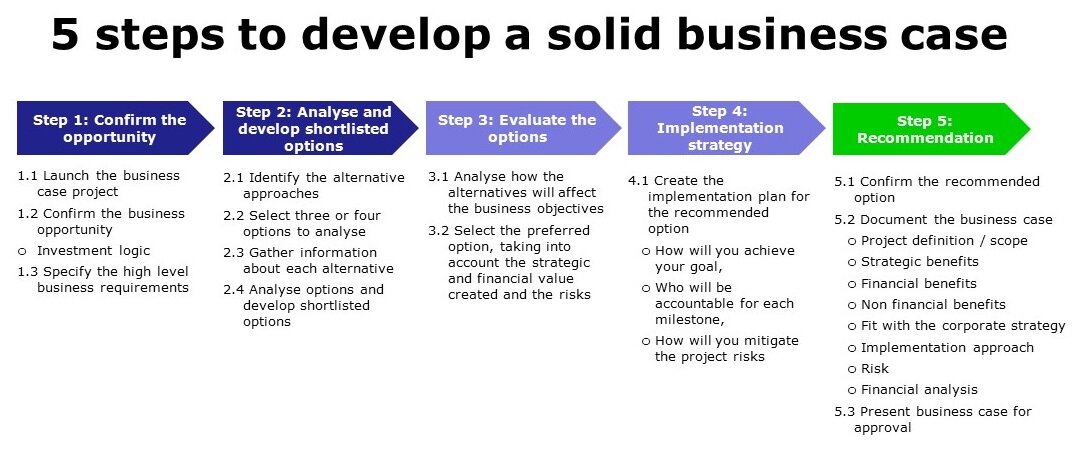
Step 1: Confirm the opportunity
Describe the situation and the business opportunity that your proposal will impact. This will include the background to the project, the investment logic and the high-level business requirements.
Step 2: Analyze and develop shortlisted options
Identify the alternative approaches and select three or four options to analyze. Gather information about each alternative, analyze the options and develop the shortlisted options.
Step 3: Evaluate the options
Evaluate how the options will deliver the business objectives, quantify the benefits of each potential solution, then select the preferred option, taking into account the strategic and financial value created and the risks.
Step 4: Implementation strategy
Create the implementation plan for the preferred option, detailing how to achieve the business objectives, the resources needed, who will be accountable for each milestone, and how to mitigate the project risks.
Step 5: Recommendation
Confirm the recommended option. Create the business case documents and present the business case recommendation to the board and management team for approval to proceed.
You will need to complete all of these steps to create a solid business case.
What to Include in the Business Case Document?
A business case document should explain the following:
-
The investment decision;
-
Key objectives for the project;
-
The business need;
-
Provide necessary background and supporting information to put the investment into context;
-
Describe how the investment aligns with the organization strategic business plan;
-
Describe the different options explored and why you are recommending this option or solution;
-
Provide a robust budget, estimate of the whole-of-life costs of the investment and its financial benefits and the projected financial statements;
-
The business benefits including an estimate of the non-financial benefits;
-
How to make sustainability core to the recommendation and outcomes.
-
Describe the approach to be used, including timelines, resources, the procurement strategy, project governance, and how to embed sustainability practices;
-
Rigorously assess the inherent risks, different scenarios and sensitivities, including how they are likely to affect the investment and outline strategies for mitigating them;
-
Convey the level of uncertainty surrounding the proposal;
-
Provide options for the board and management to consider in reaching a decision.
Who Prepares the Business Case?
Anyone in any professional role may assume responsibility for producing and writing the business case if the decision-makers trust that individual. Thus, line managers, corporate managers, business analysts, internal and external consultants, and IT managers are included.
The project sponsor or project manager may lead the development of the business case.
The goals of the recommended project, the project customers, users and stakeholders, and the business outcomes and benefits are more important than technology, domain knowledge, or deliverables in a robust business case.
The business case writer focus is on evaluating, analyzing, quantifying and delivering the business value. Poor project results can result from insufficient attention to the details of a business case and accompanying analysis.

Advantages of a Business Case
The business case document or presentation communicates the high-level information relevant to a critical decision.
The business case initiates the discussion about the required funding for a potential investment project. It is your sales pitch!
Developing business cases offers real advantages:
-
The business case helps to identify and evaluate alternatives and to compare their relative costs and benefits. A business case is a tool for strategic planning and decision-making.
-
The purpose of the business case is to outline the organization's plan for the project - risk, return, the investment required, time and financial break-even and other elements.
-
Aligning stakeholders expectations to the project's approach, outcomes and benefits of an initiative.
-
It increases the likelihood of a project's success.
-
The business case can be turned into a project plan. It highlights the project's milestones and how to apply the project resources.
-
It is easier to see success.
-
The strategy section puts the business case into context, explaining why the organization is looking to invest.
-
The justification gives a detailed breakdown of the costs, revenue, and net impact of the investment, presenting the case for the investment.
-
It explains the risks and opportunities associated with the recommendation.
Six Business Case Examples
These six business case examples highlight the different business cases organizations are developing to grow their business.
1. Infrastructure Business Case Example
This business case example is an economic business case to justify infrastructure projects or significant industry or sector projects.
Major infrastructure projects take many years to build and cost multiple billions. They also employ thousands of workers at their peak. Along the investment journey, several business cases are developed until the final business case is approved. To create the best possible business case, multiple options are explored and analyzed. Then the shortlist options are evaluated in detail to recommend the best option. These types of business cases also address environmental impacts.
Three types of business cases are developed in high-risk, high-value projects:
-
Strategic or Initial business
-
Preliminary business case
-
Full business case.
The preliminary business case or feasibility study can be more than 1,000 pages, including appendices and costing several million dollars. The full business case can cost many millions and taking at least 12 months to develop and include significant community consultations during the process.
Here is the Infrastructure Business Case for the Melbourne Metro rail tunnel project.
2. New Product Business Case Example
This business case example justifies the investment to introduce a product or service into a highly competitive market.
The business case should address:
-
Strategic positioning of the new product/service/innovation in the market.
-
Market demand and pricing.
-
Initial order quantities for products.
-
Service delivery model.
-
Customer service and supporting clients and channel partners.
3. Marketing an Innovation, Product or Service
This business case example supports the marketing strategy for an innovation, new product or service.
The business case demonstrates to prospective buyers how to justify the purchase. In addition, it explains the return on investment (ROI) from purchasing the new technology, product or service.
4. Customer Experience Business Case Example
This business case example recommends a project or initiative to improve client experience.
The business case makes the recommendation for the decision-makers to approve the project, funding and resources. It explains:
• How the client experience will be improved
• Quantities the strategic, financial and client outcomes.
• Determines the return on investment (ROI).
• Recommends the implementation approach.
5.Business Expansion and Government Grant Business Case
This business case example justifies the investment to expand and diversify the business and secure government grants.
The business case addresses:
-
The expansion strategy and the proposed investment.
-
The market demand, export growth and import replacement.
-
The roadmap to expand the business.
-
The jobs growth from the investment.
-
The outcomes for the industry or sector.
-
How the grant will bring forward the investment.
-
Why the government grant is needed.
-
How the business will fund its contribution.
6. Investment (Equity or Finance) to Scale-up the Business
This business case example seeks to raise an equity investment or finance a business or joint venture.
The business case addresses:
• The opportunity and return on investment for the investor or financier.
• How the business or joint venture will scale up and achieve the projected growth.
• Details where the funding will be applied in the business, such as capital, working capital, operating expenses, etc.
• Explains the return on investment (ROI) from the investment.
Successful Business Case Examples
Chase Consulting has been developing business cases for over twenty years. A common characteristic of our successful business cases is that we followed the 5 STEPS framework for developing business cases and used a comprehensive set of business case templates. This approach ensured that we created high-quality business cases; it saved us time and increased our productivity.
Here are six successful business case examples:
-
Improving the customer experience
-
Accelerated investment to enter new markets
-
Equity investment to scale up the business
-
Customer service improvement
-
Service planning to meet population growth
-
Business expansion to enable revenue growth
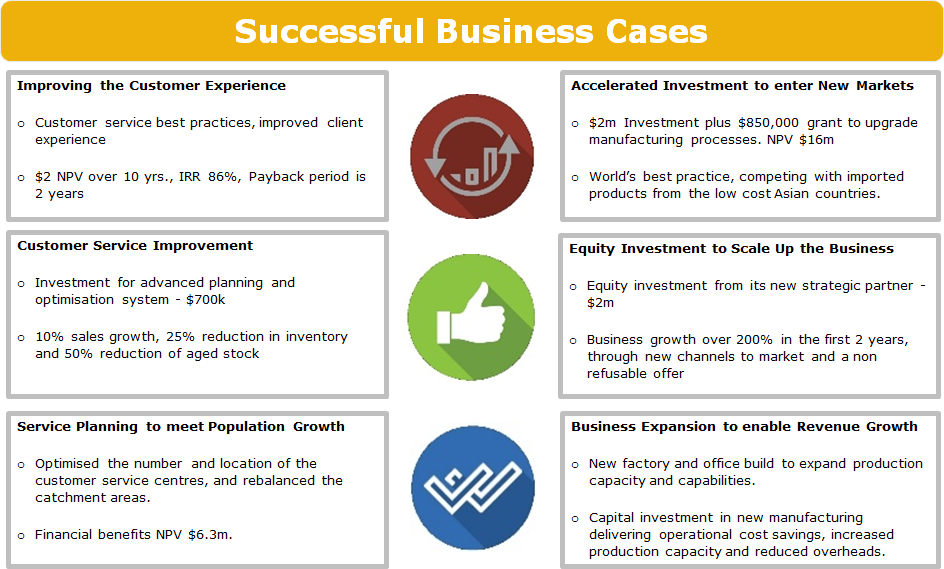
These six business case examples were successful because they clearly articulated the:
-
Recommendations and the investment decision required.
-
Strategic, financial and social benefits.
-
Options and scenarios evaluated.
-
Project financials, we strengthen these business cases by including solid financial tools, such as Net Present Value, Rate of Return, and Pay-Back Period.
-
Project timing, plus the project plan and each milestone.
-
Major risks and mitigating actions.
Before You Start Your Business Case
If you want to be sure that your business case is the best that it can be, here are a few things that you should keep in mind:
-
Think of your business case as a sales pitch with robust analysis and justification - you are creating a compelling and robust business case.
-
The process of developing a business case - use our 5 STEPS framework
-
Use the right business case templates with professional formats.
-
Write the business case for decision-makers to approve your recommendations.
-
Presenting the business case as a persuasive presentation.
-
Consider getting business case help.
A strong business case is often more than a necessity to get your idea funded. It can be used to get you up and operational as quickly as possible.
Our Business Case Guide explains the 5 Steps to Develop a Solid Business Case.
Need the Business Case Guide?
Need Business Case Templates?
Using a set of proven business case templates will increase your productivity, save you time and improve the quality of your business case.
Plus, a high-quality business case makes your project stand out amongst the competing priorities within the organization; it may be the key to getting approval and the finances for your project.
So how do you write a high-quality business case with recommendations that stand out? You know, the evidence and recommendations that management wants to support, agree with and approve.
Here's how ...
Business Case Templates

Learning How to Write Business Cases?
The How to Write Business Cases course is designed for individuals and teams who want to build their business cases using the 5 STEPS framework for successful business cases.
The course will benefit individuals and teams from all organizations, including private and public sector, and non-profit social enterprises. You learn how to create, analyze, evaluate & communicate a successful business case to meet your organization's needs

Need Business Case Advice?
At Chase Consulting, we can help you strengthen your business case. Our framework is structured and logical.
We help you develop a robust business case. We make sure that you cover all the aspects and ensure you meet the required standards.
We help you with coaching and mentoring to create compelling, results-oriented business cases to achieve your objectives. You will achieve your objectives by having clear, results-oriented business cases.

Investo a New Business Opportunity Case Solution
Source: https://www.chasegroup.com.au/five-steps-to-develop-a-solid-business-case
0 Response to "Investo a New Business Opportunity Case Solution"
Post a Comment